Friday, 30 April 2021

I Owe My Soul to the Hot Steam Core -- Frostpunk

Frostpunk is a resource management sim set in an alternate-universe Victorian era where radical climate change has lead to a new ice age. As civilization collapses into chaos amid hunger and mass death, parties of colonists have been sent out to the rich coal fields of the Arctic to build makeshift settlements huddled around massive steam-heat generators in a desperate bid to ensure the survival of the human race. (We'll just gloss over the utility of sending your last hope to the coldest place in the world when the climate is getting colder; games, as we well know here, operate according to their own internal logic.) As "Captain" of one of these settlements, you must provide your citizens with food, shelter, and most of all warmth, gather resources and build out a functioning city, research new technologies and decree new laws to adapt to the frozen hellscape, explore the wilderness to try and make contact with other cities, and make hard decisions in a situation where one wrong move can spell disaster.

As befits the timeline of the setting, Frostpunk is a decidedly industrial-revolution dystopia, and that doesn't just extend to the coal-powered steam cores and disturbingly gangly automatons. In most games like this, when you build some installation to provide you with a resource, it just keeps autonomously operating on its own recognizance; it is assumed that there are workers in there beavering away, but you don't really get to know them except perhaps as abstract and interchangeable citizens. In a way, this is a very feudalistic view of production. The peasant is attached to their workplace, and lives their entire life and dies doing the same job. But labour in Frostpunk is granular to a degree that I haven't encountered in any other game. Each worker in your settlement has a name, a face, a family, and their own wants and concerns. You must actively determine the staffing levels of almost every workplace, and many of the decisions you will make revolve around how to best employ your limited workforce and pool of skilled labour to fulfill your immediate needs while also making progress on your long-term goals. The Last City functions according to the rhythms of the factory time clock; workers work set shifts, and must be given time off for sleep, meals, and relaxation, making it paramount that you plan ahead to ensure you have enough coal on hand to feed the generator through the long, cold night.

It would be tempting to label this mechanical identity as distinctly capitalist. After all, the Victorian era was the height of unrestrained capitalism. But capitalism is tricky to portray in a video game, and the dogma that it creates the most productive civilization is far from Frostpunk's mind. There are no free markets or private property in capital in this world. Rather, it is the Captain who must decide who works where and when, how to most efficiently employ resources, what laws to decree and how to enforce them. The Last City is a planned economy from top to bottom. It could best be described as a communist state of the kind that existed under Stalin or Mao. Each works according to their ability, and each receives food, shelter, and medical care according to their needs.

However, your rule as proletarian dictator of this tiny worker's paradise is not ironclad or absolute. As in every real society, authority does not rule if the people do not consent to be ruled. Your settlement is hardly a democracy, but you must actively manage your population's hope and discontent. And again, these things are made more than just abstract bars that go up or down. Individual citizens will make their opinions about your policies known with pop-up comments that you would do well not to ignore, as they are a valuable measure of the temperature of the population. If the people's needs are not met, they will make demands, and if those demands are not met, you will be made to viscerally feel their displeasure. You can often ignore these problems with no immediate cost, but if you do so, they will begin to fester, and the impact will just be greater down the line. As the situation grows more and more dire, resistance to your regime will mount, and if you let hope die or discontent grow to uncontrollable levels, you will be overthrown and exiled, with the implication that without effective leadership, the Last City is doomed.

Now, "Frostpunk is Stalinist" is a bit of an unfair leap. But it does evince a certain philosophy about how it is necessary as a society to meet extreme challenges. Every choice in Frostpunk is a hard choice, a tradeoff where something must be sacrificed, and nowhere is this more apparent than in the game's Laws system. Laws are branching paths, and while every new law you decree brings benefits, many are problematic choices where the "morally good" option is not necessarily the best decision, if there even is a good option. Do we bury our dead in proper cemeteries, thus giving up a potentially valuable resource, or just throw them in a snow pile to freeze and preserve them for later use, making the people unhappy? Do we embrace the mechanisms of authoritarian social control to keep public order, or do we weaponize faith, the opiate of the masses, to keep the population in line and foster hope for the future? Is it appropriate to build a fighting pit for the people's entertainment? Not only do choices have consequences in the short run, but the new possibilities provided by each branch are obscured so that you don't always understand the long-term implications of your decisions. The extremely high stakes of the harsh setting combined with the realities of the historical context can lead you, even encourage you, to implement policies that would never be tolerated in the developed world in the 21st century, from child labour to 24-hour emergency shifts to using dead bodies as mulch for your hothouse. And Frostpunk seems to be telling you every step of the way that such sacrifices are justified because civilization itself is on the line.

Is that the conclusion we are supposed to draw from this? Do extreme challenges require us to become hard, to embrace authoritarianism and amorality? Are freedom, human rights, and democracy weaknesses, luxuries we can't afford when the going really gets tough? No, I don't think that's the intended message. After all, those "good" options are still there, and presumably one can still win while embracing them. Taking the high ground can give your community its own kind of strength. And the people are ultimately still sovereign in the Last City. True, they have given up their autonomy because that seems to be what is necessary for survival, but if the regime does not allow them to thrive, they will take that power back. I think the real point that Frostpunk is trying to make is that someone, whether it's a unitary leader, a command structure, or an entire populace, has to take responsibility. When things break down, the Captain is the one who ultimately takes the hit. When the hard decisions are let slide too long, there will inevitably be a reckoning.

The allegorical implications for our own era of rapidly accelerating climate change are starkly clear. We are facing hard, life-or-death, existential choices as a society, and part of the reason those decisions are not being met head-on is because they are in the hands of a passive and stupefied populace who allow themselves to be led by greedy and incompetent cronies of the pampered elite trying to preserve their own power and luxury at the possible expense of the existence of humanity as a species. The answer, I would hope, is not dictatorship; as Frostpunk makes clear, even that is not is an effectual solution if you can't give the people what they want and need. But what we're doing right now is not working, and if we don't find a way to change our course, catastrophe is on the way.

Sunday, 3 January 2021

Come Drink in my Tavern, Said the Spider to the Fly -- Lords of Waterdeep

 Lords of Waterdeep is one of a host of board games set in the Forgotten Realms campaign setting for the popular tabletop roleplaying game Dungeons and Dragons, although I will be referencing the computer version for the purposes of this post. Players take on the personas of the eponymous Lords, the shadowy masked members of the ruling council of the premiere trading city of the Forgotten Realms, as they compete for prestige and control. It is a fairly basic worker placement game, considered appropriate for newcomers to the genre; players send their agents to various locations in the city to recruit adventurers and to the Cliffwatch Inn to claim quests which they then send these adventurers to complete for victory points and other rewards. They can also construct various buildings which provide more attractive options to all players at the cost of giving free resources to the player that owns them, and finally, may send agents to Waterdeep Harbour to play intrigue cards with a wide variety of game effects. Skilled play lies in predicting and playing around other players' strategies, managing continuously decreasing and expanding options, and building a foundation that will serve you well in the late game.

A picture of one of the Lords of Waterdeep.
A mere hint of personality for my hidden scoring card - a strong, independent woman with the cunning to swim with the sharks and the learning to fly with the eagles.


As Lords of Waterdeep is not a particularly deep example of the Euro-style game, a lot of the appeal lies in the Dungeons and Dragons flavour and the evocation of the theme and world of the Forgotten Realms. Quests range from the relatively mundane -- lure dwarven craftsmen to the city, domesticate owlbears -- to standard fantasy-adventure fare -- raid an Orcish outpost, expose a hidden temple to the demon-goddess Lolth -- to underhanded political subterfuge -- destroy a rival criminal organization, infiltrate Waterdeep Harbour with a spy. Intrigue cards also evoke a variety of espionage tactics, from innocuous actions like calling in a favour or offering free drinks at your tavern to lure away opponents' adventurers to assassinations and other dark double-dealings. Thus, every game tells a story of who betrayed whom, who saved the city from the rampaging beholder, who was a glory hound, a craven blackguard, a wheeler-dealer on the make. And players literally construct the city of Waterdeep, making it their own with iconic locations that players versed in the lore of the world will readily recognize. The combination of theme and mechanics does an excellent job of evoking the idea of influential eminences grise manipulating events behind the scenes and pulling the strings of power to their own ultimate benefit.

A game board with several pieces placed.
A mid-game board state. Often you must make choices that are sub-optimal for your game plan and still come out ahead.


And this is kind of fascinating on a number of levels. In the typical Dungeons and Dragons campaign. the focus is on heroic adventurers on a quest for glory, striving to set wrongs right and save the world from destruction at the hands of dangerous tyrants (or alternatively, the focus is on murder hoboes, depending on the nature of your gaming group). Those at the behest of whom the player characters take on these mighty deeds, the humble merchants, village mayors, lords, kings, mighty wizards, and more exotic denizens, definitely play second fiddle, usually given the status of "quest givers", an entire person with their own hopes and dreams reduced a plot contrivance. In the hands of a good Dungeon Master, these characters can become much more fleshed-out and three-dimensional, and a really good one can evoke the background of power and influence which lie behind the feats of derring-do required by the plot. But ultimately, these people are necessarily secondary characters in someone else's story, accessories to the heroes' need for dragons to slay and princesses to rescue.

Lords of Waterdeep flips that script right onto its head. Adventurers here become mere wooden cubes, nameless and faceless pawns to be used in the plots and counter-plots of shadowy benefactors they might never even know the identity of. The glorious quests they undertake become moves in a game of power, radically recentered from those that undertake them to the much more interesting individuals that sponsor them. It is not even known if the adventurers live or die when confronting the foes of Waterdeep or engaging in skullduggery for their hidden masters. It brings to life the sub-rosa world that lies beneath the surface of the simple and straightforward heroes' journey in a way that is very difficult for a standard tabletop roleplaying campaign. And in so doing, it reveals some interesting things about the nature of political institutions in the setting it portrays.

The final score of the game is displayed.
The final score. My Lord has come out on top - this time. But there will always be another game.


Everyone is the hero of their own story, but all of us are caught up in the network of institutions and power relations that make up the social world. In Lords of Waterdeep, adventuring and questing itself seems to be an institution; adventurers are defined types with an infinite supply waiting around in taverns to be recruited in a standardized process of undertaking dangerous deeds. This is not an uncommon social structure to exist in role-playing games, but it is interesting in the way it subverts classic heroic fantasy tropes in which the characters are exceptional individuals destined to make their mark on history. And the game also says some very enlightening things about institutional power in Waterdeep. The very fact that such people as tavern keepers, real-estate speculators, and hidden doppelgangers must take up the reins of power and send their hired mercenaries to do what must be done to keep the city running is indicative of the nature of government in this unstable and constantly threatened city. It is a city-state of canonically weak central authority, more like a Renaissance Italian city than a classic medieval-fantasy kingdom, a continual power vacuum of constantly shifting factions and alliances, as is appropriate for a setting in which players may be challenged by webs of intrigue and deception. And although in this story the wealthy and powerful take centre stage, in such a setting even they are caught up in a web of competing interests, condemned to play an eternal power game in which the final scoring round is never truly reached.

Sunday, 4 October 2020

Press X to Not Die, #GirlBoss -- Tomb Raider (2013)

 Within the first several minutes of Tomb Raider, Lara Croft is nearly drowned, impaled on a spike, and has to fight off a man that, if you are not quick-thinking and agile, will kill you with a handmade axe in an intensely intimate fashion.

For a male action hero, this is all in a day's work. We would not even blink to see a man subjected to this kind of violence in a movie or video game. But when it's a woman -- especially a frightened, disoriented woman inexperienced in facing violence -- things get a little more complicated.

I'm sure that Tomb Raider needs no introduction. This critically acclaimed reboot of a franchise going back to the 90s shows the origin story of famed archaeologist Lara Croft. While striving to live up to the legacy of her dead father, Lara and a boatload of comrades are shipwrecked in the Dragon's Triangle and wash up on an island which is the former home of an ancient Japanese god-queen, and the present home of an insane cult hoping to resurrect her. Mechanically, it's set firmly in the grand tradition of its forebears, a third-person adventure game involving traversal, shooting, puzzling, collecting, and of course the inevitable quick-time events. Priority is given to immersion; there are no health bars, precise gear loads are obfuscated, and the inevitable RPG elements are cloaked in a descriptive veneer to hide their naked mechanical advantages. It's a pretty linear experience, predating the open-world live services that are popular these days, and it has a difficulty level that makes it accessible to even a filthy casual like me. All in all, I'd say it deserves its reputation as one of the best games of the decade; I had lots of fun with it.


Lara croft crouches behind a barrier while being assaulted by cultists.
Facing off against a squad of cultists. Some things never change.


For years, Lara Croft was held up as the icon of Feminism in gaming, a badass chick that could hold her own against the likes of Doomguy and Duke Nukem. There was even talk of how playing as a strong female character like Lara could serve as a role model for girls and make teenage males steeped in the toxic macho culture of gaming more sympathetic to the plight of women in society. But in recent times, the discourse around female characters in media has changed, and the designers of Tomb Raider quite plainly took some of those ideas on board when reinventing this iconic gaming franchise.

The most immediately apparent difference between 2013's Lara Croft and her 1990s namesake is that she's less... she doesn't have such... she isn't as... there's no polite way to put this: her boobs aren't as big. Not A-cups by any means, but not pornstar-sized either; reasonably proportioned. That's hardly the most important change, but it does seem to encapsulate the direction in which the devs have chosen to go when reinterpreting the character. Lara has also lost a lot of the sass and wisecracking nature of her hyper-competent forbear. She's hardly a shrinking violet; in addition to being a trained archaeologist, she's athletic and competent with a bow, able to easily climb rock faces and leap off of crumbling bridges. She also has an innate survival instinct, translated mechanically into the ability to highlight important environmental objects, that will serve her in good stead in the coming trials. But here at the beginning of her career, Lara is not the flippant and frankly mannish globetrotting superstar of the franchise's earlier (and later) outings. She has emotionally vivid relationships with other characters, and projects a kind of vulnerability that makes the terrible things that are happening to her deeply threatening in a way that games rarely really accomplish. She is just a relatively normal young woman who finds herself in a bad situation and has to do whatever she has to, learning to kill and to survive under the harshest of trials.


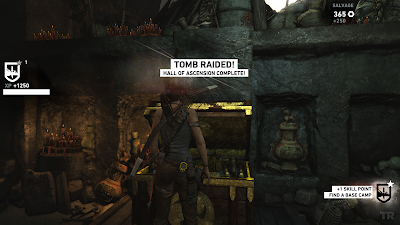
Lara has penetrated the depths of a tomb. The legend "Tomb Raided" is displayed in bold.
It would hardly be Tomb Raider if you didn't get to raid some tombs, now would it?


And that's kind of a problem, because mechanically, the game doesn't really keep up with this change in mood. One minute Lara is almost puking after having to shoot a man for the first time; the next she's gunning down armies of cultists with practiced ease. She wails and gasps at every new terror, yet takes dozens of bullets with barely a wince. She is motivated by her interpersonal relationships to pursue goals with deep urgency, yet is willing to take time off at any given moment to track down collectibles and infiltrate ancient ruins -- her deep scientific curiosity getting the better of her, I guess. This makes for a rather schizophrenic experience, as the story the devs want to tell about an average woman having to overcome adversity and survive against all odds butts up against the gamer fantasy of going HAM on an island full of bad guys. I'm not saying it makes the game bad, but it does kind of undermine the idea that this is a new Tomb Raider for a new generation of women gamers, that this Lara Croft is a realistic portrayal of a female character with a deep interior life, that the bad old days of a woman built like a stripper cracking one-liners with a gun in each hand are gone.

My wife absolutely loathes Lara Croft and Tomb Raider. She hates the fact that for years, such a blatant sex object was pointed to as proof that the industry and gaming culture was not sexist -- let us remember that Lara's infamous bustline was the result of a programming error that was loved by adolescent playtesters -- and she has told me that the aftertaste of years of seeing women in gaming portrayed this way has permanently soured her on the franchise. She is not going to play the new Tomb Raider; she is not going to experience the growth in the way the developers think of women as characters. When you make a bad enough first impression, it's not good enough sometimes to make amends and beg forgiveness later. The damage has been done.

Sunday, 6 September 2020

Throwing Bricks at Cops is a Good Idea -- Tonight We Riot

 Tonight We Riot is a retro-style brawler in which the player is the leader of a revolutionary anti-capitalist movement which must fight its way through the city block by block, liberating the oppressed workers of a futuristic dystopia and breaking through waves of violent riot police on their way to ridding their society of bourgeois parasites and creating a classless utopia. You play not just as one character, but as a mob of radicalized proletariat; as leader, you take the vanguard and direct your comrades in battle, but if one leader falls, another automatically takes their place. As you rampage through the city, picking up bricks and Molotov cocktails (the weapons of the people) and gaining numbers by organizing workplaces, you will be faced with gradually more and more deadly police violence, starting with "nonlethal" truncheons, water cannons, and rubber bullets and proceeding to more naked displays of deadly force and futuristic weapons of mass slaughter, until at the end of each stage you send the capitalist pigs packing and claim a new part of the city for the worker's paradise.

A band of revolutionaries discovers caches of weapons.
These piles of bricks conveniently left lying around bring to mind recent accusations that police have done exactly this during BLM protests to encourage violent riots which they will then have an excuse to crack down on.


Tonight We Riot wears its ideological commitments on its sleeve. It is a full-throated exhortation not just to revolution, but to violent insurrection. As we have seen before, to make an engaging game, some aspects of reality must be left out; the nuts and bolts of organizing a revolutionary coalition capable of amassing sufficient force to challenge the institutionalized violence of the state is left in the background, and so is the broader picture of what the revolution means for society in general, to focus on the immediate process of direct action in the streets. But the game also implicitly forecloses the possibility of change through anything but violent overthrow of bourgeois democracy. Every organ of society is turned against you, from the capitalist economic system itself, to the militarized police who defend it, to the popular press who manufacture the consent of the populace, to the electoral machine that puts only corrupt corporatist stooges in power. In the tradition of Marx, the democratic process is seen not necessarily as suppressed, or even fixed, so much as simply ineffectual. There are no reformists or incrementalists or social democracies in this world, just the cold reality of naked state brutality and the call to arms of the people to struggle and fight for their freedom.

Revolutionaries wave a flag of victory while they count their dead
At the end of each stage, you get a score based on how many comrades you managed to not get killed. A grim reminder that the revolution cannot be without martyrs.


Obviously, I am writing this against the background of the recent and ongoing mass protests against police brutality occurring in the US, and the attendant response that has seen police become even more brutal and repressive, defending the state's monopoly on violence in a way that only further demonstrates the merits of the protesters' assertion that the institution's monopoly on violence is fundamentally illegitimate. Though they started with riots, looting, and the burning of a police station, the protesters have been forthright about the need to remain peaceful and nonviolent in their methods, even as the chattering classes fixate on the comparatively minor incidence of rioting, the police interpret any resistance whatsoever to their war crimes as rebellion, openly fascist paramilitaries engage in their own intimidation and murder, and random people get dragged off the street into unmarked vans by anonymous individuals without uniforms or badges. And for a while, it seemed as if the protests were beginning to accomplish their goals, with multiple jurisdictions promising reform and even one city council voting to dissolve the police department altogether, but such gains have disappeared like the tide as the fickle media and public have moved on to fresher, shinier controversies. Too, this article will be posted in the lead-up to one of the most consequential elections in US history, with one side openly attempting to suppress the vote, and the other seemingly unable to make a convincing case for why they should be the ones elected; a culmination of decades of reactionary neoliberalism and expansion of government power during which the left have failed miserably to build a coalition that can enact meaningful change through the ballot box while the extreme right does unrelenting violence to democratic norms. And with all that taken into account, it feels hard sometimes to believe that the advocates of revolution doesn't have it right.

A headline in teh Factory Town news reads "Mechanized Justice: Cold metal claws bring hot justice to the streets:
Darkly sarcastic headlines between each stage indicate the public reaction to your revolutionary crusade. Not promising, is it?


I can't help but admit that Tonight We Riot paints an appealing picture. There is a visceral happiness to seeing the downtrodden just uncompromisingly win for once. Anyone who has been the target of police harassment (as I and a lot of people I know have) can understand the joy in the idea of smashing a pig's face in with a brick, of blowing up a car just for the sake of showing them that you won't be crushed under the iron heel, of breaking out the guillotines and sending those suit-wearing, briefcase-carrying crypto-fascists fleeing for their lives. Of course, not to be all "you participate in society, gotcha", but the great irony is that this piece of what can only reasonably be described as anti-capitalist propaganda in game form makes huge corporations money every time it is downloaded. After all, the good comrades at Pixel Pushers Union 512 still gotta eat. And so the machine continues to churn, grinding up every rebellious urge of the population and spitting it out as more product to consume. However, the most subversive message of Tonight We Riot is not just that violent revolution is an option that is on the table, but that it is possible to win such a revolution. And hey, it's not like it hasn't been done before, and it's not beyond the realm of possibility that it can be done again. But there is something about the vision of those little pixelated figures, revolutionaries and cops alike, smeared across the screen in a gush of cartoon blood that is deeply unsettling. And what scares me the most is not the prospect of such a violent uprising as a legitimate means of social change, but that maybe it is the only possible means.

Sunday, 28 June 2020

Life, the Universe, and... -- Everything

Everything is an open-world sim in which the player takes the role of a sort of spark of life in a quest for the meaning of its own existence. The player starts their journey as one of an extremely wide variety of plants, animals, or natural and man-made objects; When I started playing, I was put into the body of a polar bear. The player then roams the environment, slowly picking up clues about what they are capable of as they interact with the stray thoughts of other things. The core mechanic involves inhabiting more and more of the other various things that make up your surroundings; from the body of a polar bear, you can jump into a tree, a rock, a clump of grass, or a woolly mammoth. That's the game's big selling point: you can "be everything". Once you have come to know this body by "singing" to the rest of the universe, you add it to your directory of things, and can become that thing again as desired. You can also join groups of these things together, and have them dance; and that's really about it as far as mechanics go. As you wander and add more and more things to your lexicon, you will also be occasionally gifted with audio files of quotations from a lecture by British philosopher Alan Watts.

A polar bear rolling around.
Just a polar bear rolling. You know, as they do.

And there's the real point. Everything is the most deliberately and self-consciously philosophical game I have yet to play. Although serviceable, the gameplay and graphics have an almost deliberately unpolished look; animals aren't even animated, but move in a sort of herky-jerky rolling. I don't like to impute sinister motives to creators, but the style of the game seems like a deliberate attempt to give the impression of the game as being an "art piece", like the developers had more important things on their mind than merely making a good game. And once you've tired of accumulating more and more things in your library and watching penguins or spruce trees dance, the game becomes mostly an over-complicated way to listen to an Alan Watts lecture. The lecture in question is about the theory that there are "no such things as things", that divisions between one thing and another are arbitrary and unreal, that humans are merely an expression of the universe trying to know itself. 

Floating thought captions.
The 'mind' full of thoughts I've encountered. Some of them feel remarkably try-hardish.

This definitely gives context to the game's mechanics, but it sort of leaves one with the impression that they are being talked at by the devs, rather than invited to join in a conversation. Is this an effective way to communicate your thesis in a game? The strength of games as argumentative tools is in their ability to involve the player in a system, to illuminate an idea through doing, through simulation of actions and reactions. The fact is that after a while, actually playing Everything seems a bit pointless. To make it an effective didactic tool, the devs might have profited from making the mechanics a bit more complicated and involved, giving the player more to do, and making the quotes a bit harder to come by; add some actual play to this game. As it is, Everything really leaves me cold, and I absolutely love philosophy and also largely agree with the point that is trying to be made. If even I, the definition of the intended audience, find that it falls short, what hope can it have with anyone else?

Sunday, 7 June 2020

Carnival of Microtransactions -- Raid: Shadow Legends

So I finally got sucked in. After being bombarded with ads and offers on the various gaming-related YouTube channels I follow, I caved and decided to support one of my favourites by accepting their blandishment of free stuff, and downloaded Raid: Shadow Legends. After all, so many people whose opinions on gaming I trusted were saying that this game was a lot of fun, and could they all really be lying through their teeth for profit? So I downloaded the game, made an account, gritted my teeth, and gave it a try.

And honestly, it's not the worst game I've ever played. The core gameplay loop is pretty bog-standard JRPG-style tactical turn-based combat, shorn of all of the extraneous exploration, puzzles, and all but the barest hint of plot and character development. The centrepiece is the collection and management of the game's endless stable of unique champions -- from Orcs, Elves, ad Dwarves to holy paladins, undead revenants to knights and barbarians to ferocious Lizardmen, each with a unique set of skills and their own strengths and weaknesses. It's a pleasant enough way to kill time.

But oh my god, is this game lousy with monetization. It uses pretty much every psychological trick in the book, and as such, it makes for an awesome case study in the way that modern games' financial models function. I don't know if Raid is particularly worse than any other free-to-play game on the market, but it is definitely the worst that I have ever had the pleasure of playing; and yet, it's still fairly enjoyable. But that enjoyment comes at a psychological cost.

An orc warrior and a list of other heroes.
My stable of champions. Not pictured: the parade of common cannon fodder who have fueled their advancement.

To start with, there are the endless array of limiting factors. As Jim Sterling likes to put it, there's the "bullshit currency", silver, which is fairly freely available and which is required to perform almost any action in the game from summoning champions to upgrading weapons to improving skills, and the "real currecny", gems, which are drip-fed to the player but also available for real-word money and can in turn be traded for anything the player needs. Then, almost everything either needs or benefits from an additional extra item to perform -- shards of various capability to summon champions, the vast majority of which will be the near-useless commons (literally a party of level-1 common champions can't even beat the first level of the campaign) and whose main utility is as fodder to improve your more important heroes; skill books to improve skills, potions to "ascend" them, chickens to improve their rank from rare to legendary. All of which can be obtained through gameplay, but all of which are also available for a price in precious gems. There's also an energy meter which depletes as you engage in actual gameplay, and further tokens needed to fight other players' teams in the arena. I have seen this described by other games as an "anti-poopsocking" measure designed to stop the player from going for days without stopping play, but conveniently, all such games seem to provide methods of refilling or extending your energy ... for a price. You get tons and tons of such resources as a new player, especially if you've redeemed one of the endless head-starts offered by various YouTube channels, but eventually the silver and the excess energy has to run out, and you're stuck with whatever dribble the game will still allot to you, unless you choose to pay.

A party of champions destroying their enemies.
Actual gameplay: my primary party in the process of destroying the hopelessly outmatched opposition.

Then, the relentless driving of engagement. The game has a free hand with the play rewards. There are of course increasing bonuses for logging in every day, rewards just for spending time playing the game, and a roster of daily, weekly, and monthly quests, plus a wealth of missions, challenges, and tournaments that ensure the player never lacks for something to do to earn a little reward. These intermittent hits of dopamine from progress and free stuff are addictive, and missing out on something you could have had with just a little more play feels pretty crappy. A really dedicated investigator would have tried to complete all of the time-dependent quests to see if you can actually do them all without paying, as a lot of them require limited-supply items to finish, but frankly, I just don't enjoy the game enough to spend that much time on it. This is all of course framed as a "reward", but we must keep in mind that what the player is being given is a solution to a problem the game itself creates, a problem of limited resources which is primarily present not to make gameplay more challenging or satisfying, but to present a barrier that can be surmounted, if the player chooses, by spending real money. And the more time the player spends on the game, the more investment they have in their champions and tournament ranks, the more tempting spending that money becomes. Then there is the classic trick, when upgrading weapons, of making the occasional upgrade fail -- a psychological tactic called "intermittent rewards" employed to great success in gambling institutions, requiring further investment of resources while exploiting the sunk-cost fallacy and the weaknesses of the dopaminergic system to encourage the player to give it just one more try.

A list of daily quests.
Just look at all of the busywork I am expected to complete every day for a few gems.

The final piece is of course the advertising. Raid is blatant in its promotion of its paid services. There are a continual stream of bundles and deals being offered by pop-up ads, all time-limited to play on FOMO and purchase-quantity-limited to create an artificial illusion of scarcity. There's a free shard item available in the store every day; that gets the player regularly visiting the storefront, with its array of tempting deals on offer, and I have definitely caught myself thinking "Hey, this bundle is only a buck thirty-nine! That's a steal!" In addition to the ability to directly purchase the items you need to advance and keep playing, there are a number of places where premium-currency gems can be "invested" to create a continuing gameplay benefit, giving the player a sense that they are building something of real worth, especially if what they have invested is not mere time and effort, but cold, hard cash. The game even gives me notifications in my fucking windows system tray! And there is the advertising blitz that got me into the game in the first place, that offer of a fortune in silver and a premium champion from those we trust to give us gaming content; all of those professional game content creators lying, if my experience with the game is any guide, through their teeth to sell this Skinner box psychological torture, each endorsement reinforcing the others until social proof gets the better of you, as it did me.

An ad for a bundle of in-game resources.
You get hit with about a half-dozen of these every time you go back to home base.

Practically everything about the game is a calculated inducement to spend money. Which raises an interesting question: How much actual game can be removed from a game of this type before it ceases to be an actual game? Now I'm not saying that Raid involves no actual gameplay at all; there are plenty of others that would suffer in comparison. At its best, the combat can be a real challenge, as is the meta-game of picking the champions whose capabilities suit your play-style, figuring out which ones make a holistically effective party, and managing the byzantine system of character levels, weapon levels, character ranks, skill levels and ascensions, perks, whole-game advantages, and so on. But I find that in a lot of cases, my party is either vastly overpowered or vastly underpowered, with muscling through the actual battles either trivial or impossible. It is pretty rare to actually be in a situation where your characters are exactly the right power lever to make the encounters a tough but winnable challenge. The game even provides a convenient auto-battle option to save you from the tedious drudgery of actually choosing your moves when victory is a foregone conclusion. And actual battle, engaging in the core gameplay loop, is not what most of your playtime will consist of. Most of playing the game as a non-"whale" actually involves playing the monetization system, choosing which activities to engage in to generate maximum free value for time invested while battling the constant psychological pressure to just pay. Raid involves perhaps the minimum possible level of challenge required to be considered an actual game, and not just an unnecessarily complicated way of spending money for pretty virtual goods.

The sad part? I'm probably going to keep playing, even now that I've completed my study and analysis of the game. It's got its hooks in me. Missing out on my next daily reward, losing my progress toward that sweet legendary champion, and leaving all the quests I have started unfinished would be psychologically painful. The game may not have actually gotten any money out of me, but it's winning the battle.

Sunday, 12 April 2020

It's a Bird! It's a Plane! It's ... Some Guy! -- Sentinels Of The Multiverse

Sentinels of the Multiverse started life as a tabletop card game, although I have lately been playing the computer version. I have played it before, defeating all of the included villains and then growing bored, but I just recently got a good deal on all of the DLC, so I dove back in and have been having a lot of fun revisiting it. The game plays out as a comic-book-style battle between three to five superheroes and a dastardly villain; it's intended to be played cooperatively, although the video game port allows you to play solo and satisfy your inner alpha gamer. Each superhero plays from a deck of cards and uses various powers and special abilities that they either start the game with or develop progressively; the villain then plays programmatically based on an algorithm set out on their character card and draws from a villain deck, while an environment deck filled with dangers and plot twists, like a bustling metropolis or a dinosaur-filled jungle, throws its own wrenches into the works. Even when heroes go down, they can still help their teammates through a choice of powers on the back of their character card, and villains cards flip between two sides that provide variety to their play.

A giant hand damages the hero Legacy.
Legacy takes a hit from the villain's terrible might hand.


You won't find any copyrighted DC or Marvel characters in Sentinels of the Multiverse, but the heroes definitely have a familiar ring to them. There's Legacy, the team leader and a pretty clear Superman clone; The Wraith, a kind of female Batman; Tachyon, an obvious copy of the Flash; Bunker, a beefier version of Iron Man; and Tempest, who ... well, Tempest is a bit more of an original character, like a combination of Storm, Aquaman, and a Skrull. Let it not be said that Sentinels is full of blatant ripoffs. As the expansions ramify, the characters become more and more individuated and creative, though many of them are still clearly inspired by other better-known intellectual properties. The villains, too, are pretty familiar faces; for instance, the tutorial antagonist, Baron Blade. He has a death ray, he has an army of henchmen and brilliant devices, and just when you think you've defeated him, he comes back even more powerful than before. There's a rampaging AI, an alien conqueror, a master assassin, a primeval force of nature. The brilliant thing about Sentinels is that, within a fairly simple set of basic mechanics, every hero and every villain plays differently, and each mechanically reflects the characteristics of the archetype they embody. Legacy bolsters and sacrifices himself for his teammates, the Wraith employs stealth and deploys a barrage of gadgets, Tachyon plays a flurry of action after action, and Bunker switches between power-suit modes that specialize in one or another aspect of gameplay. The mechanics and theme of this game are perfectly in tune.

A primal force of nature looms above and taunts assembled heroes.
A laudable, if somewhat generic sentiment.

The employment of ersatz heroes and standard types has a long and beloved history in comic books themselves. Looking for Supermans? You can take your pick; in addition to countless spinoffs, reboots, and re-imaginings from the Communist Superman of the brilliant Red Son  to the bizarre bearded maniac of Superman: at Earth's End, there are plenty of unmistakable knock-offs: the title character from the self-aware homage Supreme; the Samaritan from Kurt Busiek's loving tribute to comic archetypes, Astro City; the subversive Omniman from Invincible and his eponymous son; and too many others to exhaustively catalogue. Superman is of course a valuable intellectual property, and one may not reproduce his likeness without the permission of the owners of that property, though that line has become blurred with the growing benign neglect of such rights when it comes to fanfiction and fanart. But in the majority of cases, if one wants to tell a Superman story without access to the Superman license, or to tell a story exploring the concept of Superman without necessarily involving the character himself, one must necessarily turn to disguises, obfuscations, and winking nods.

A game state of a game of Sentinels of the Multiverse in which the villain has 7 minions in play. The heroes are clearly in bad trouble.
Things can get pretty hairy if the cards don't go your way. I wish I could say I bounced back from this.

But that raises an interesting question. What is it exactly that makes Legacy so clearly a dollar-store version of Superman? After all, Legacy is not a refugee from a doomed alien planet, nor does he gain his powers from the yellow sun of Earth; he is a normal human whose superhuman abilities come from a magic ring passed down through generations of his family. He has blonde hair, not black, and his skin-tight bodysuit is primarily white with blue accents, not primarily blue with red accents. He may be quite strong, but he does not seem to have the ability to set entire planets on different orbits, nor is he invulnerable -- he takes damage from attacks just like any of the other heroes. Obviously, if we are to maintain that Legacy is in some sense the same character as Superman, these superficially defining attributes are not in fact essential to the character.

Well, Superman has been called the Big Blue Boy Scout. He is a leader, and he leads from the front, using his invulnerable body to shield others from harm; as mentioned before, Legacy's abilities also involve him taking damage for the greater good. And Superman, by his moral example, charisma, and unfailingly (most of the time) optimistic outlook, inspires his teammates in the Justice League to strive their utmost and persevere in the face of adversity; likewise, Legacy's signature power is to increase the damage dealt by other heroes, and alternate powers involve the same kind of bolstering of other players' abilities. Finally, though he has at times been portrayed as a super-genius, Superman has a tendency to turn first to force to solve problems, as employing unmatched force is what he's best at; and Legacy's cards also tend to go for the jugular and portray employment of brute strength rather than cleverness, guile, or knowledge. Other off-brand versions of Superman tend to embody similar attributes, or in some cases to play with them and deconstruct their implications. So these, rather then the actual details of Superman's biography, appearance, or exact set of powers, might better serve as definitional of the "Superman archetype".

A defeated villain is in prison garb and handcuffs; the heroes' winning statistics are displayed beside.
Justice is restored, but something tells me it's not the last we will see of this rogue.

The concept of an archetype was first introduced by psychologist Carl Jung as a description of deep aspects of the human unconscious personality that drive our behaviour. Jung thought that reflections of these divisions of the self showed up in mythology and repeated in every culture's traditional stories, a concept that was further codified by Joseph Campbell in his concept of the "hero's journey". Superhero comics, among other genres, have often been described as modern mythology, and the concept of the archetype has been applied to such repeatedly reproduced sets of characteristics as we have been discussing. There is something about Superman, about Batman, about mad scientists like Baron Blade that calls to something deep in our psyche, and that is why we keep endlessly reinventing them. Superman himself is just one version of a character type that is as old as human civilization -- a Galahad, a Cu Chulainn, a Siegfried, an Arjuna; a paladin, a carrier of a culture's deepest values and a reflection of what it desires itself to be. Superman embodies Truth, Justice, and the American Way, and Legacy by implication stands for similar values. There is a little Superman in all of us, appealing to the angels of our better nature, whispering to us that righteousness can triumph over evil, that the innocent can be protected from the predators of the world, if we can only apply martial force in a just and measured way. And that is why, although Superman the Last Son of Krypton and his iconic "S" may be copyrighted intellectual property, the idea that is embodied in Superman, in Legacy, and in a hundred other heroes never can be. If one expression is locked up by a corporation eager to capitalize on its popularity, another will inevitably arise. The archetype is the common property of all humanity, an expression of the collective unconscious that cannot die, that cannot be owned, and that cannot be controlled.